• Safety
  • Environmental stewardship
  • Diverless operations
  • Oceanographic discovery

Subserv operates small remote-operated vehicles for hull, dock, dam inspections and research support down to 300 metres, launched from a boat, a pontoon, dock or the shore.

Three vehicles, one pilot, a sea of possibilities. When a diver is needed we can provide diver support and observation.

Our aim on every job is the same: work safely, leave the environment as we found it, and give our clients an answer they can act on.

What we do

0–300 m

Every job comes back the same way: recorded video from splash to recovery, stills of anything worth a second look, and a written summary you can hand to a surveyor, an engineer or insurer.

0–15 m

Hulls and running gear

Plating, welds, anodes, sea chests and gratings, propellers, rudders and shaft seals. Class and insurance survey support, damage checks after a grounding or a strike, and a look at a boat before you buy it.

0–30 m

Marina and dock structures

Pile condition below the waterline, pontoon floats and connections, mooring chain and anchor blocks, scour around footings, and whatever has gone over the side between the fingers.

to 300 m

Dams and hydro intakes, wall condition

Trash racks and intake screens, gate seals, upstream faces, sediment build-up and penstock entries. Water that is cold, dark, confined or moving is exactly where a vehicle earns its place over a diver.

0–300 m

Oceanographic research support

Vehicle and pilot for survey teams — transects, reef and habitat records, mooring and instrument checks, and placing or retrieving gear on the bottom. You direct the science; we fly the vehicle and hand over the footage.

0–300 m

Search and Recovery

Outboards, tenders, anchors, tools, phones and dropped gear. Sonar-assisted searching, and grabber recovery for objects within its lift or that a line can be attached to. We also work alongside emergency services at their request.

Where each vehicle can go

Working envelope

Most inspection work lives in the first twenty metres, and either battery vehicle handles all of it straight off a dock. The reason for keeping a third, heavier system is everything below that line — and the current, cold and confinement that comes with it.

Deep Trekker DTG2
100 m
Fifish V-EVO
100 m
SeaBotix vLBV300
300 m
0–20 m berths, pontoons, hulls afloat
20–100 m Dam intakes, deep moorings, gear on a steep bottom. All three reach it; the vLBV300 holds station better in a flow.
100–300 m Deep structure and research transects. vLBV300 only.

Depth ratings are the manufacturers’ figures for these vehicles. Working depth on any given day is set by tether length, current and visibility, and we will tell you before mobilising if the job sits close to a limit.

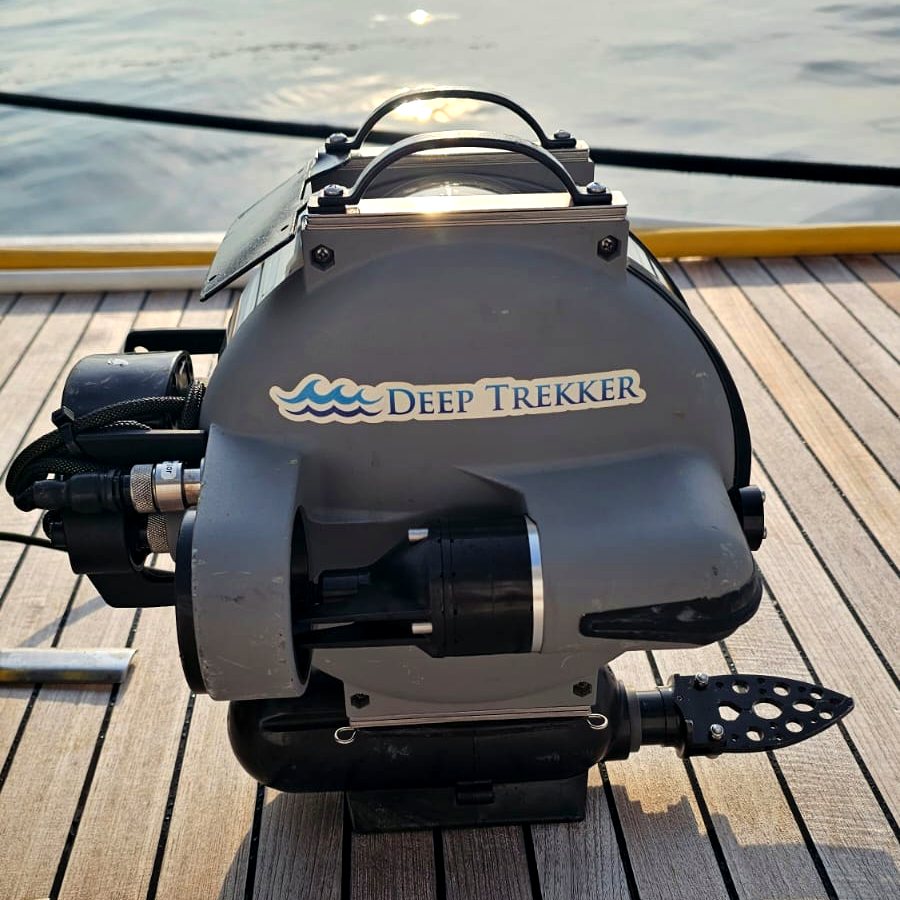
The Deep Trekker DTG2 on a vessel deck, with water and low sun behind it.

The vehicles

Three systems

Two battery vehicles for shallow work and one powered system for depth and current. All three travel in transit cases and go in off a dock, a tender or the shore — no crane, no support vessel, no dive team.

Deep Trekker DTG2

Deep Trekker Inc. · Kitchener, Canada

Battery powered and light enough to carry to the water in two hands. No generator, no power cable, no reel to rig — it goes in off a dock or a tender and it is filming within minutes. The patented internal pitch system tips the whole vehicle, so it can look straight up at a hull or straight down at the bottom without a separate camera mount.

Depth rating100 m · 328 ft
Weight in air8.5 kg · 18.7 lb
Dimensions325 × 258 × 279 mm
BodyDie-cast aluminium, acrylic port
Propulsion2 thrusters, internal pitch drive
Speed2.5 knots
Endurance4–8 h on internal batteries
CameraLow-light colour, 270° rotation
LightingLED flood, tracks the camera
ManipulatorGrabber, 2 degrees of freedom
Tether100 m, 4 mm low-drag, no topside power

Fifish V-EVO

QYSEA · Shenzhen, China

The camera of the fleet. Six thrusters give it six degrees of freedom, so it holds an attitude and tracks sideways along a pile or a hull instead of swinging to face what it is looking at. A 4K sensor behind 10,000 lumens of light is what turns coating breakdown, fouling type and hairline cracking into findings rather than impressions. The optional gripper lifts small objects clear.

Depth rating100 m · 328 ft
Weight in air3.9 kg · 8.6 lb
Dimensions383 × 331 × 143 mm
Propulsion6 vectored thrusters, 6 degrees of freedom
Speed3 knots
Enduranceup to 4 h on a charge
Camera4K UHD, 166° field of view
Lighting2 × 5,000 lumen LED
ManipulatorParallel gripper
TetherFixed 100 m spool

SeaBotix vLBV300

Teledyne SeaBotix · San Diego, USA

The heavier system, for depth, current and anything that needs pushing against. Four horizontal thrusters set at an adjustable vector angle, plus two vertical ones, give it equal thrust in every direction and the pull to hold position in a flow. Auto depth, auto heading and thruster trim keep it steady while you concentrate on what you are looking at.

Depth rating300 m · 1,000 ft
Weight in airapprox. 18 kg · 40 lb
Propulsion6 brushless DC — 4 vectored, 2 vertical
Vector angleAdjustable, 45° / 35° / 20°
Speed3 knots at surface
StabilityAuto depth, auto heading, trim
SensorsDepth, heading, temperature, imaging sonar, USBL
ControlIntegrated console, daylight monitor
Topside power3,000 W surface supply
ManipulatorGrabber, 1 degree of freedom
Tether150 m and 300 m, low-drag, neutrally buoyant

How a job runs

Mobilisation to reporting

You describe the job

Where it is, roughly how deep, and what you need to know. If a vehicle is the wrong tool we will say so before agreements are signed.

We mobilise

Vehicle, tether, console and spares travel in transit cases. We work off your dock, your boat or the shore — no support vessel needed for shallow work.

The dive is recorded

Video runs from splash to recovery with depth and heading on the overlay, so nothing that turns up later is missing its context.

You get the findings

A look at the console while we are still on site, stills, the full recording and a written summary within a few days.

What you receive

  • The complete dive recording, uncut, with depth and heading overlay
  • Still images of every defect, obstruction or item found
  • A written summary in plain language, not survey shorthand
  • Raw files, so your own surveyor or engineer can look for themselves
  • Position notes for anything we found but did not recover

Where a diver is still the answer

These vehicles look, record and pick up small objects. They do not clean, cut, weld, patch or lift anything heavy, and in zero visibility a pair of hands still beats a camera.

If your job needs contact work, we will tell you that at the enquiry stage rather than after we have arrived.

Apps for people who work on the water

Software

Two tools built from the paperwork of real offshore jobs. Both keep working with no signal.

Subsea Logger

Android · iPhone · iPad · in testing

ROV, manned submersible, chamber operator, commercial diving and seaman’s discharge book logbooks in one app, with medical, safety and training certificates, expiry warnings and PDF summaries to send to an employer. Everything stays on your own device.

About Subsea Logger

Checklist app

Android · iPad · in development

Checklists that need proof: photos and video stamped with time and position, readings with limits, colour-coded answers that flag problems, rectification records and signatures, finishing with a branded PDF report.

About the Checklist app

Tell us where the job is.

Subserv mobilises internationally, so send the location, the depth and what you need to see, and you will get an honest answer about whether we can reach it and whether these vehicles are the right tool for it.

enquiries@subserv.org

Worth putting in the first email

  • Where the job is, and how we would get to the water
  • Roughly how deep, and how far out from shore
  • What you need to know — a condition check, a specific defect, or something to find
  • Visibility and current on a normal day, if you know them
  • When you need it, and who the findings are for